Bhagavad Gita 1.23
Arjuna Vishada Yoga · English Translation
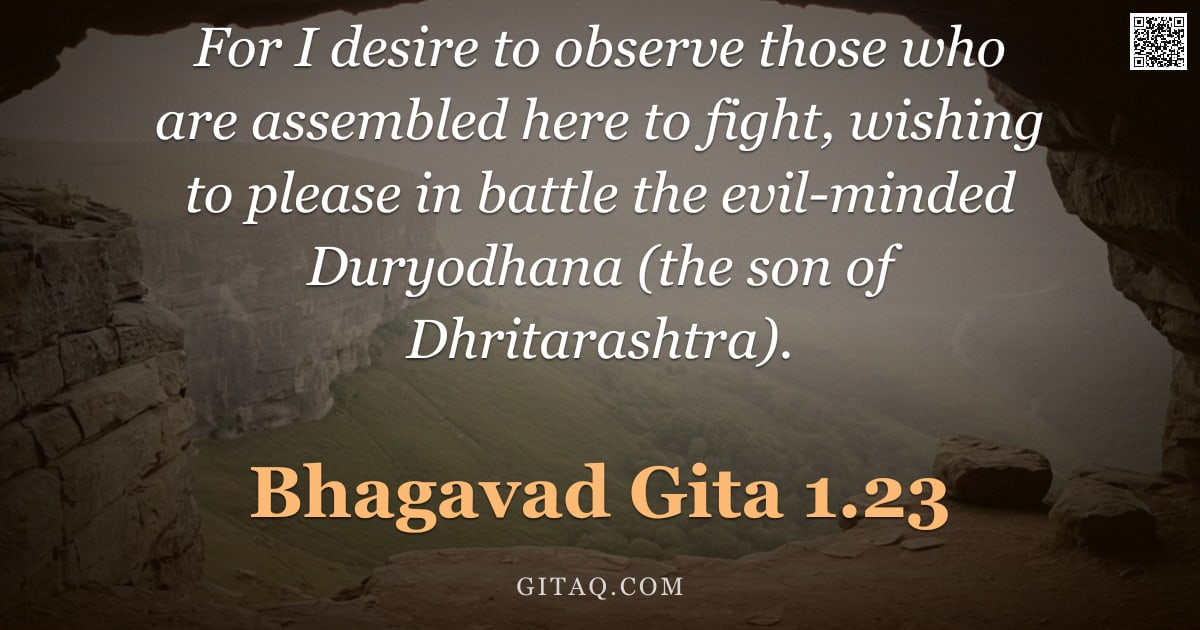
योत्स्यमानानवेक्षेऽहं य एतेऽत्र समागताः | धार्तराष्ट्रस्य दुर्बुद्धेर्युद्धे प्रियचिकीर्षवः ||१-२३||
yotsyamānānavekṣe.ahaṃ ya ete.atra samāgatāḥ . dhārtarāṣṭrasya durbuddheryuddhe priyacikīrṣavaḥ ||1-23||
What Does This Verse Mean?
In this verse, Arjuna expresses his desire to look at the opposing army before engaging in battle. He specifically mentions that these warriors are gathered there to fight for Duryodhana, whom he describes as having an evil mind. This moment captures Arjuna's initial hesitation and his wish to assess who is fighting against him due to their allegiance to a flawed leader.
The Teaching Behind It
This verse belongs to the initial stage of Karma Yoga, where one must first clearly perceive the reality of a situation and their own motivations before acting with detachment. It develops the concept that true action requires witnessing the consequences and the nature of those involved without immediate emotional reaction or confusion.
Word by Word
Where This Happens
This verse occurs immediately after Arjuna has positioned his army opposite the Kauravas on the battlefield of Kurukshetra. He asks Krishna, who is serving as his charioteer, to turn their chariot between the two armies so he can see the elders and relatives fighting for Duryodhana's side. The listener in this moment is Arjuna himself, but he is speaking internally or aloud to Krishna while feeling a deep sense of dread about facing his own family.
Living It Out Today
Before making a difficult decision at work, such as launching a controversial new product that might upset long-term partners, take time to clearly identify all the stakeholders involved and understand their motivations. Just as Arjuna needed to see who was on which side before acting, you should pause to assess the people affected by your choice rather than rushing in blindly. This moment of observation helps clarify whether the potential gain is worth the relational cost.
Explained for Children
Imagine you are about to play a big game of tag or soccer with your friends, but before the whistle blows, you want to see exactly which team you will be playing against. Arjuna felt like this; he wanted to look at everyone standing on the field because they were there to fight for his cousin Duryodhana, who was making some very bad choices. It is a natural feeling to pause and check out the other side when things get scary or confusing.
Daily Reflection
You find yourself standing on a battlefield of your own making, eager to prove something or perhaps just wanting to be seen as ready for the fight ahead. Like Arjuna looking at his kin with a desire to engage, you might realize that your drive often comes from a need to please others rather than an inner clarity. This verse invites you to pause before acting and ask if your motivation is rooted in true wisdom or simply in seeking external validation.
A Practice for Today
Sit quietly and visualize yourself as Arjuna at the start of this great conflict, looking out with eyes full of longing yet confusion. Ask your heart: 'What is it I truly wish to please in my own battles today?'
Key Teachings
- The Clarity of Observation
Before action can be taken, there must be a moment of deep seeing. Arjuna pauses to observe the reality of his opponents rather than rushing into blind aggression. - The Trap of External Validation
Our actions are often driven by a desire to please others or gain their approval, even when it conflicts with our conscience. The verse highlights how 'wishing to please' can obscure the true purpose of one's duty. - The Shadow of Duryodhana
Duryodhana represents the 'evil-mindedness' that seeks victory through conflict rather than righteousness. We are reminded to identify and resist the internal impulses that mirror this destructive desire for dominance over others.
Themes
Related Verses
Read This Next
- 2.47 — After observing the battlefield in Chapter 1, Krishna immediately introduces Arjuna's primary duty: acting without attachment to results.
- 3.30 — This verse deepens the practice of detachment by instructing one to offer all actions and their fruits directly to the Divine.
- 12.15 — To understand who truly pleases God, read this description of a devotee who is dear because they cause no disturbance to others.
Recommended Reading
GitaQ earns from qualifying purchases as an Amazon Associate.