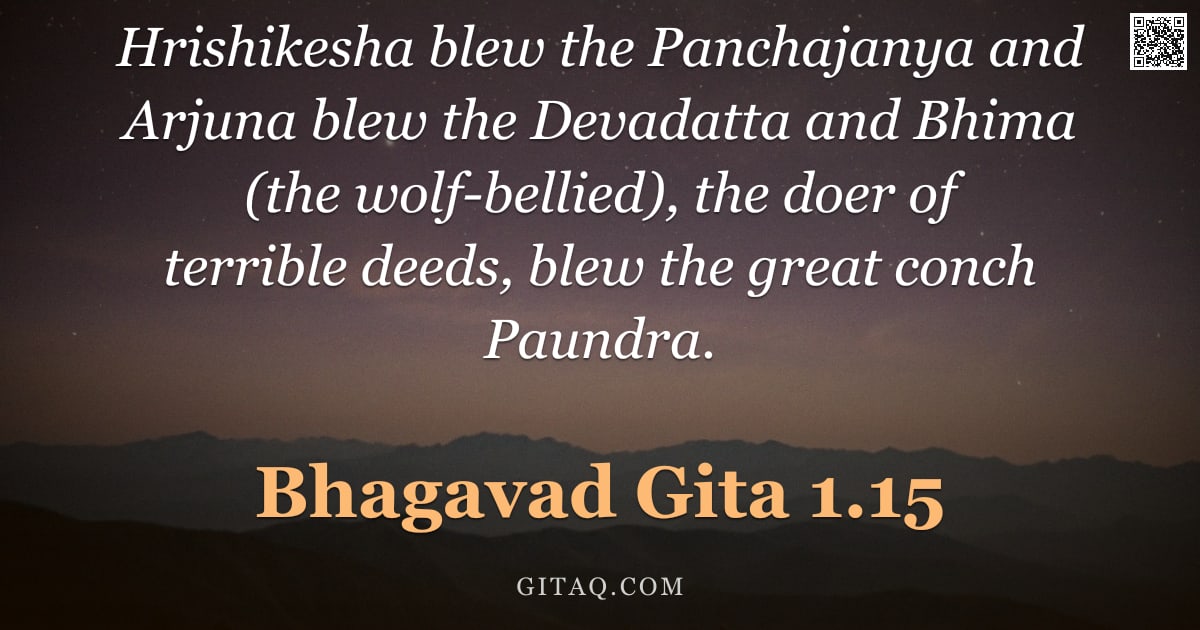
Bhagavad Gita 1.15
Arjuna Vishada Yoga · English Translation
पाञ्चजन्यं हृषीकेशो देवदत्तं धनञ्जयः | पौण्ड्रं दध्मौ महाशङ्खं भीमकर्मा वृकोदरः ||१-१५||
pāñcajanyaṃ hṛṣīkeśo devadattaṃ dhanañjayaḥ . pauṇḍraṃ dadhmau mahāśaṅkhaṃ bhīmakarmā vṛkodaraḥ ||1-15||
What Does This Verse Mean?
This verse describes the moment when Krishna, Arjuna, and Bhima blow their respective divine conch shells to signal the start of a great battle. The names of these individuals are highlighted as titles reflecting their qualities: Krishna is the Lord of the senses, Arjuna is the conqueror of wealth, and Bhima is known for his fierce strength. By blowing the conches together, they create a deafening sound that awakens courage in their allies and strikes fear into the enemy ranks before any arrows are even fired.
The Teaching Behind It
This verse is foundational to Karma Yoga (the yoga of selfless action) as it depicts warriors preparing for duty without attachment to fear or sorrow. It illustrates that true preparation involves aligning one's actions with a higher purpose and using natural qualities like strength and discipline as offerings in service.
Word by Word
Where This Happens
This verse occurs at the very beginning of the Kurukshetra war in the Mahababarata's epic battle between the Pandavas and Kauravas. After Arjuna had expressed his despair over fighting his own relatives, Krishna (the charioteer) has just finished teaching him about duty, and now they prepare to enter combat. The blowing of these specific conches marks the formal declaration of war by the three most powerful warriors on the Pandava side.
Living It Out Today
Imagine you are a team leader facing a critical project deadline where everyone is anxious and unsure if success is possible. Like Krishna, Arjuna, and Bhima sounding their horns to unite and energize your group, you can make a clear, decisive announcement that cuts through the noise of doubt. By confidently stating the plan and your readiness to act, you shift the team's energy from hesitation into focused action, setting the stage for overcoming the challenge.
Explained for Children
Imagine you have three friends who each own a special, magical horn. Before a big game starts to see which team is strongest, everyone blows their horns at once! The first friend's horn makes a loud sound that reminds us Krishna controls his mind perfectly. The second friend's horn shows Arjuna will win the prize of wealth and honor. The third friend's horn sounds like a giant wolf roaring because Bhima is so strong he can do amazing things. Together, their horns say 'We are ready to play our best game!' just before everyone starts running onto the field.
Daily Reflection
Today, remember that true courage isn't about silence; it is about finding and using your distinct voice for what is righteous. Just as Arjuna and Bhima each had their own powerful conch, you possess unique talents and a specific role only you can fulfill in this moment of life's battle. Do not wait for perfection or the perfect conditions to begin; simply blow your shell with the conviction that your contribution matters.
A Practice for Today
Visualize your own unique instrument of duty, just as the warriors held their conch shells to signal readiness for what was necessary. Take a deep breath and ask yourself: What is my 'Panchajanya' or 'Devadatta'—the specific action I must perform with full awareness right now? Let this moment be a call to awaken your inner strength before you step into the world.
Key Teachings
- The Individuality of Duty
Each soul has a unique instrument and capacity, symbolized by the distinct conch shells like Panchajanya or Devadatta. Your spiritual path requires you to identify your specific strengths rather than trying to copy another's role. - The Power of Righteous Action
Blowing a conch is an act that demands courage and precision, representing the necessity of engaging in one's dharma. The verse highlights Bhima as 'the doer of terrible deeds,' showing that even fierce actions are virtuous when aligned with cosmic order. - Communal Readiness
The collective sound of the conchs signals a unified front, reminding us that we fight our battles not in isolation but as part of a greater whole. Your personal awakening contributes to the spiritual momentum and harmony of everyone around you.
Themes
Related Verses
Read This Next
- 2.47 — Read this next to understand how to perform the duty signaled by the conch without attachment to the outcome.
- 3.30 — This verse follows up on the call to action, instructing you to offer all your deeds and their results to the Divine.
- 12.15 — After learning about duty, this section describes the qualities of a devotee who finds peace in such active service.
Recommended Reading
GitaQ earns from qualifying purchases as an Amazon Associate.