Bhagavad Gita 3.11
Karma Yoga · English Translation
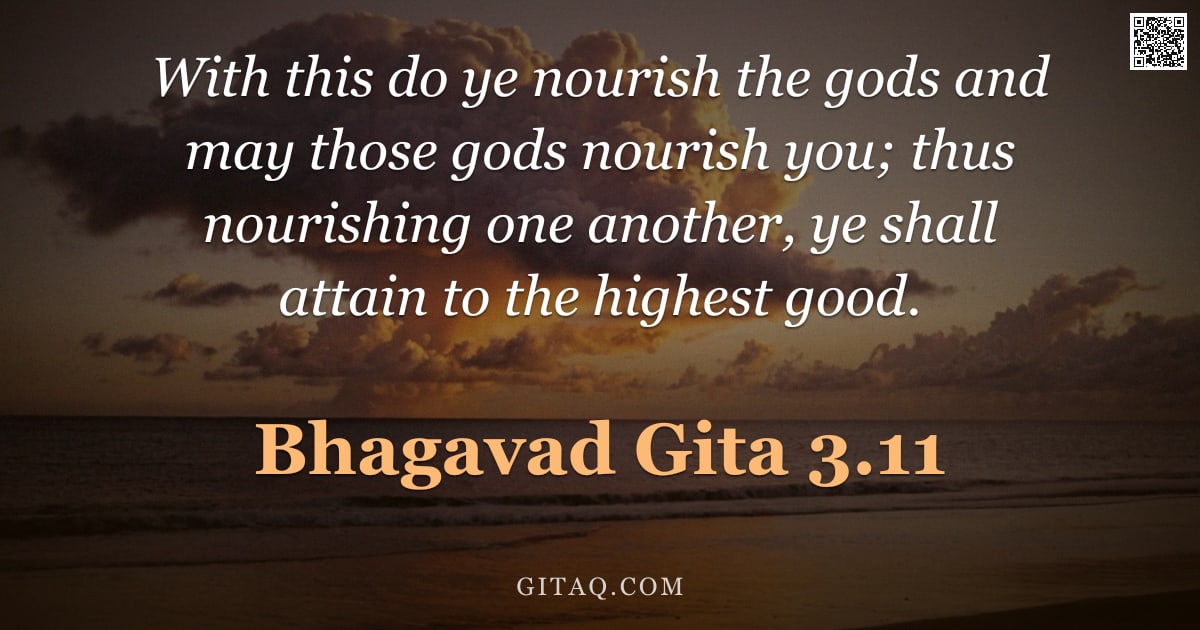
देवान्भावयतानेन ते देवा भावयन्तु वः | परस्परं भावयन्तः श्रेयः परमवाप्स्यथ ||३-११||
devānbhāvayatānena te devā bhāvayantu vaḥ . parasparaṃ bhāvayantaḥ śreyaḥ paramavāpsyatha ||3-11||
What Does This Verse Mean?
In this verse, Lord Krishna instructs Arjuna that by performing one's duties selflessly as an offering to the divine forces of nature (the gods), those same forces will sustain and nourish us in return. This creates a cycle of mutual care where humanity supports the cosmic order through righteous action, ensuring harmony for everyone involved. The key teaching is that true fulfillment comes not from taking from the world, but from giving back through our work without attachment to personal gain.
The Teaching Behind It
This verse is a cornerstone of Karma Yoga, specifically illustrating the concept of 'Yajna' (sacrificial action) as the bridge between individual duty and cosmic harmony. It teaches that there is no separate entity performing or receiving; rather, existence functions through a reciprocal exchange where selfless service sustains both the devotee and the cosmos.
Word by Word
Classical Commentary
Where This Happens
This verse is spoken by Lord Krishna to Arjuna on the battlefield of Kurukshetra during the Mahabharata epic, specifically within Chapter 3 which focuses on Karma Yoga. Just prior to this, Arjuna had expressed confusion about whether he should fight or renounce action entirely; Krishna has just begun explaining that inaction is not a solution for an active soul. The context establishes that duty must be performed as a sacrificial act to maintain the cosmic order (rita), which was on the verge of collapse due to Adharma.
Living It Out Today
Consider a software engineer working late on a critical project; instead of focusing only on their bonus or promotion, they view the code as a service that will help users solve real problems. By dedicating this work with sincerity and care (nourishing the 'gods' of truth and utility), they build trust within their team and reputation in their industry. Consequently, opportunities arise naturally for career advancement and collaboration, demonstrating how selfless professional effort creates its own rewards.
Explained for Children
Imagine you and your friends are in a circle passing balls; when one person throws a ball to another, they get one back later because someone else threw it. Krishna says we should do good deeds like sharing toys or helping at home for the 'gods' (the forces that make life work), and then those same forces help us grow stronger and happier in return. If everyone plays fair and helps each other instead of just taking, our whole world becomes a better place where everyone gets what they need.
Daily Reflection
You often feel like the sole provider in your circle, carrying the weight of responsibility alone, but today remember that you are part of an ancient cycle of mutual care. Just as farmers feed humanity through their harvests, you too offer something vital to the world simply by living with intention and generosity. When you shift your focus from 'what can I get' to 'how can my actions sustain others,' you unlock a profound peace where no one is left wanting.
A Practice for Today
Close your eyes and visualize every action you perform today not as a task for yourself, but as an offering that feeds the cosmic order of life. Ask silently: 'How does what I do right now nourish those who depend on me?' Let this awareness transform your routine into a sacred exchange.
Key Teachings
- The Law of Mutual Nourishment
This verse establishes that the universe functions on an exchange; we feed the divine forces through our duties, and they in turn sustain us. It teaches that isolation is impossible because every action creates a ripple effect that either enriches or depletes the whole. - Action as Worship
Your daily work becomes an act of devotion when performed to nourish others rather than solely for personal gain. This transforms mundane tasks into 'yajna' (sacrifice), elevating ordinary existence into a spiritual practice. - The Path to the Highest Good
True fulfillment is found not in accumulation, but in this reciprocal flow of giving and receiving. By nurturing one another through righteous action, we naturally attain 'parama shreya,' or the supreme well-being.
Themes
Related Verses
Read This Next
Recommended Reading
GitaQ earns from qualifying purchases as an Amazon Associate.