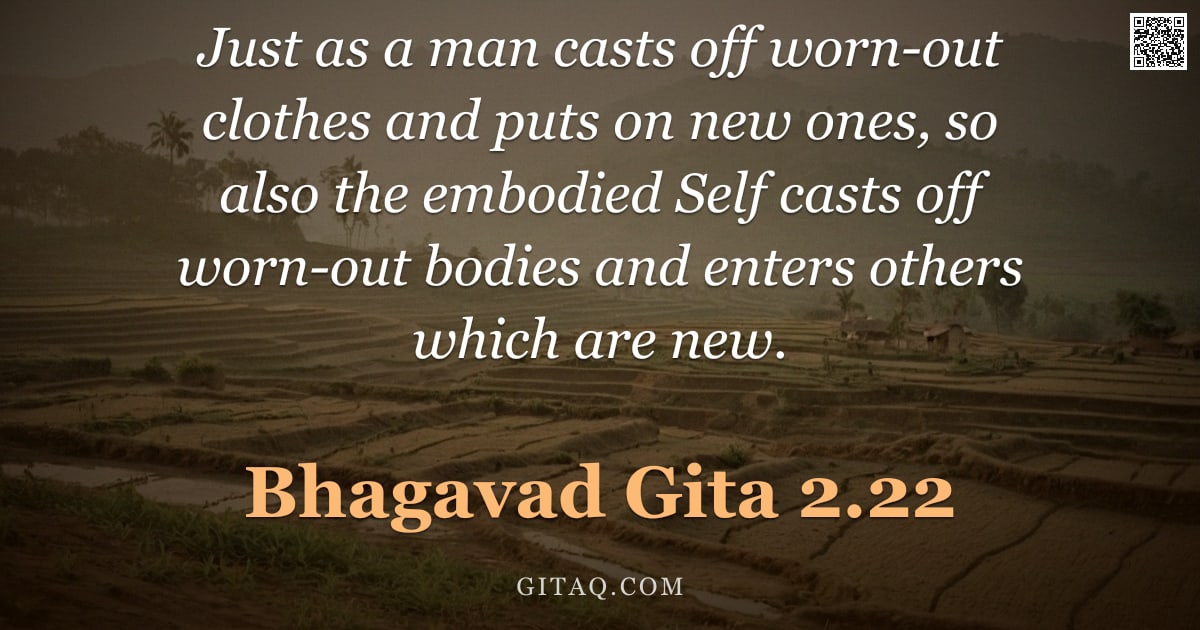
Bhagavad Gita 2.22
Sankhya Yoga · English Translation
वासांसि जीर्णानि यथा विहाय नवानि गृह्णाति नरोऽपराणि | तथा शरीराणि विहाय जीर्णा- न्यन्यानि संयाति नवानि देही ||२-२२||
vāsāṃsi jīrṇāni yathā vihāya navāni gṛhṇāti naro.aparāṇi . tathā śarīrāṇi vihāya jīrṇāni anyāni saṃyāti navāni dehī ||2-22||
What Does This Verse Mean?
In this verse, Lord Krishna is speaking to Arjuna on the battlefield of Kurukshetra to comfort him after he expressed deep grief over fighting his own kin. The core teaching uses a familiar analogy: just as a person discards old, worn-out clothes and puts on new ones without any loss or fear for their identity, the true self (Atman) similarly leaves an aging body at death and enters a fresh one. This verse aims to shift Arjuna's perspective from mourning physical destruction to understanding that the soul is eternal and unchanging.
The Teaching Behind It
This verse is a foundational teaching of Jnana Yoga (the yoga of knowledge) and Sankhya philosophy, specifically developing the concept of 'Sattva' regarding the distinction between the permanent Self (Atman) and the temporary body. It establishes that death is merely a transition or transformation rather than an annihilation, forming the logical basis for non-attachment in Karma Yoga.
Word by Word
Where This Happens
This verse appears in Chapter 2 of the Bhagavad Gita, where Prince Arjuna has laid down his bow and wept on the battlefield of Kurukshetra, paralyzed by attachment to his teachers and relatives. Lord Krishna begins His discourse with Sankhya Yoga (the yoga of analysis) to dismantle Arjuna's delusion that death is a permanent end or a tragedy for the soul. The context follows immediately after Krishna has questioned Arjuna's grief as unworthy of an honorable warrior, setting the stage for explaining the immortality of the self.
Living It Out Today
Consider someone going through a major career change where they must leave behind a job that no longer challenges them or fits their current skills. Instead of fearing the loss of identity associated with leaving that role, they can view it as discarding 'worn-out clothes' to step into new opportunities better suited for their evolving talents. This mindset reduces anxiety about the unknown future and allows them to embrace professional transitions with confidence rather than grief.
Explained for Children
Imagine you have a favorite pair of shoes that are so worn out they no longer fit your feet, or maybe they are too small for you now. You wouldn't cry because those old shoes don't work anymore; instead, you happily take them off and put on a brand new pair that fits just right! The story says we are like the person wearing the shoes: our bodies might get sick or grow old like old clothes, but your true self is safe inside, ready to step into a new body when the time comes.
Daily Reflection
Today, notice where you are holding onto fear of change as if it were permanent loss; remember that just like clothes, this body is merely a temporary vessel. The 'you' that feels anxiety or joy has always been the same witness behind every transition you have ever faced. Trust that your inner self is eternal and safe, regardless of how often new circumstances arrive to take the place of old ones.
A Practice for Today
Close your eyes and visualize yourself gently shedding an old, heavy coat that no longer fits or serves you. Imagine a fresh, light garment appearing instantly to clothe the same spirit within, symbolizing how your true essence remains unchanged while outer forms shift.
Key Teachings
- The Distinction Between Self and Body
Arjuna learns that the 'dehī' or embodied self is distinct from the physical vessel it inhabits, just as a person is not their clothes. This separation establishes that death is merely an exchange of form rather than the destruction of the soul. - The Natural Law of Impermanence
Just as worn garments are naturally discarded for new ones, aging and dying bodies follow a natural cycle governed by time. This teaching removes the stigma from death, reframing it as a necessary transition rather than a tragedy. - The Continuity of Consciousness
While external forms change continuously, the inner consciousness remains constant and unbroken through every lifetime. Recognizing this continuity allows one to face life's challenges with equanimity rather than attachment or grief.
Themes
Related Verses
Read This Next
- 2.47 — This verse follows naturally by teaching how to act in the world without attachment, which is possible once one understands they are not their changing body.
- 3.30 — Reading this next shows how to dedicate all actions and results to the Divine, reinforcing the idea of transcending personal identification with the temporary self.
- 12.15 — This verse describes the qualities of a devotee who has realized these truths, becoming free from distress by understanding their true nature beyond matter.
Recommended Reading
GitaQ earns from qualifying purchases as an Amazon Associate.