Bhagavad Gita 18.62
Moksha Sanyasa Yoga · English Translation
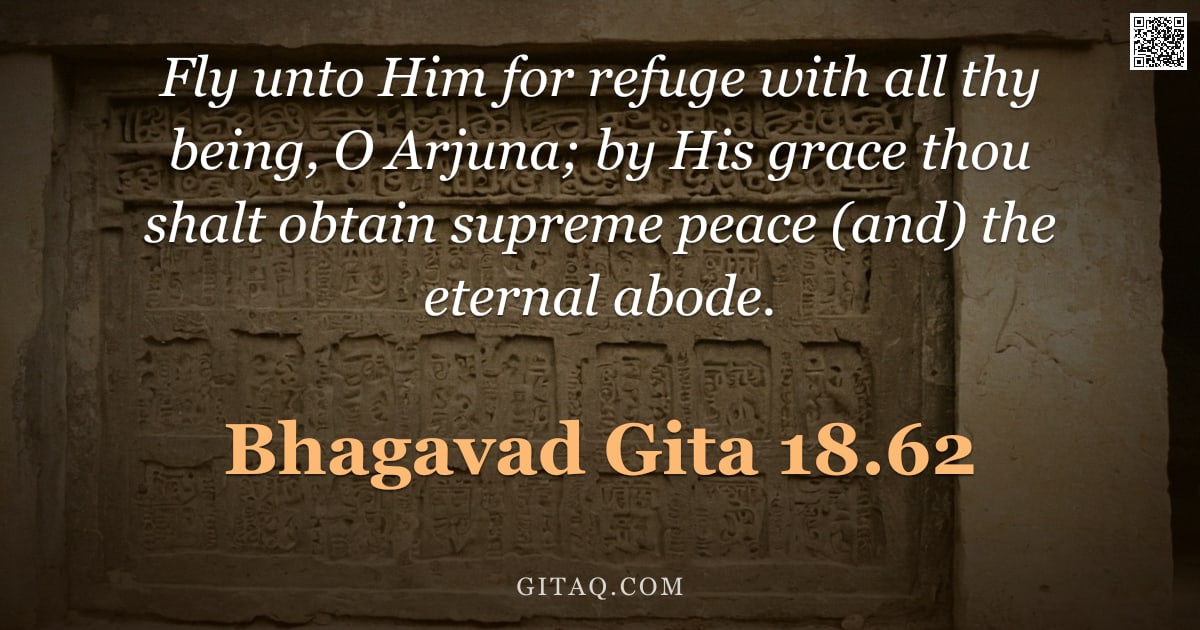
तमेव शरणं गच्छ सर्वभावेन भारत | तत्प्रसादात्परां शान्तिं स्थानं प्राप्स्यसि शाश्वतम् ||१८-६२||
tameva śaraṇaṃ gaccha sarvabhāvena bhārata . tatprasādātparāṃ śāntiṃ sthānaṃ prāpsyasi śāśvatam ||18-62||
What Does This Verse Mean?
In this verse, Krishna urges Arjuna to surrender completely to the Divine as his only refuge during times of confusion and fear. He promises that by offering one's entire being in trust, a person will receive God's grace, which leads to supreme peace and an eternal state of freedom from suffering. The core teaching is that true resolution comes not through personal struggle alone, but through total reliance on the higher power.
The Teaching Behind It
This verse is a quintessential declaration of Bhakti Yoga (the path of devotion) while serving as the culmination of Jnana Yoga (knowledge). It develops the concept that intellectual understanding must eventually transform into total emotional and spiritual surrender, where the individual ego dissolves in trust to receive divine grace.
Word by Word
Classical Commentary
Where This Happens
This verse appears near the very end of the Bhagavad Gita during the conversation on the battlefield of Kurukshetra, just before Krishna concludes his teachings. Arjuna is still overwhelmed by moral confusion regarding fighting in the war and has not yet fully committed to action or surrender after hearing about various paths like karma yoga and jnana yoga. Having received a comprehensive overview of philosophy, Krishna now delivers this final instruction as the ultimate solution: total surrender.
Living It Out Today
Consider a professional facing an impossible deadline where every strategy seems to fail and anxiety is paralyzing their decision-making process. Instead of obsessing over every detail or forcing a result through sheer willpower, they can practice 'surrender' by doing their absolute best with focus while mentally releasing the outcome to something larger than themselves. This shift in perspective reduces stress, clarifies thought, often leads to more effective action, and brings an inner calm regardless of the external result.
Explained for Children
Imagine you are lost in a huge forest with no map; instead of trying to walk blindly until you get tired or scared, Krishna says just hold tight to your wise guide's hand. If you trust them completely and let them lead you, they will show you a safe path where there is always peace and happiness forever. So when things feel scary or hard, it helps to stop fighting alone and ask for help from the one who loves you most.
Daily Reflection
In moments where life feels overwhelming or directionless, remember that true peace does not come from forcing control over every outcome. When you shift your focus from self-reliance to divine reliance with an open heart, the chaos settles into a profound stillness. Today, I invite you to release the heavy armor of trying to be everything for everyone and simply rest in grace.
A Practice for Today
Close your eyes and visualize dropping every burden, expectation, and fear you carry into the vast hands of the Divine. Breathe deeply and silently affirm that you are surrendering not just a part of yourself, but your entire being to this higher refuge.
Key Teachings
- The Call to Total Surrender
Krishna commands Arjuna to approach Him with 'sarvabhāvena,' meaning the entirety of one's being, not just a fragmentary or partial devotion. This teaching establishes that liberation requires an undivided heart where no other object holds equal claim. - Grace as the Catalyst for Peace
The verse explicitly links supreme peace to 'tatprasādāt,' indicating that divine grace is the necessary condition for attaining lasting tranquility. While human effort initiates the journey, it is the Lord's blessing that ultimately resolves all inner conflicts. - Eternal Abode Beyond Temporal Existence
The promise of 'sthānaṃ śāśvatam' points to a state of being that transcends the cycle of birth and death, distinct from temporary worldly happiness. This eternal abode is not merely a place in space but a stable spiritual reality achieved through complete surrender.
Themes
Related Verses
Read This Next
- 2.47 — To understand the foundational principle of performing duty without attachment, which prepares the mind for total surrender.
- 3.30 — This verse elaborates on dedicating all actions to God, serving as a practical application of the 'all being' concept in this chapter.
- 12.15 — To see how Krishna describes those who are dear to Him after they have attained peace through surrender and devotion.
Recommended Reading
GitaQ earns from qualifying purchases as an Amazon Associate.