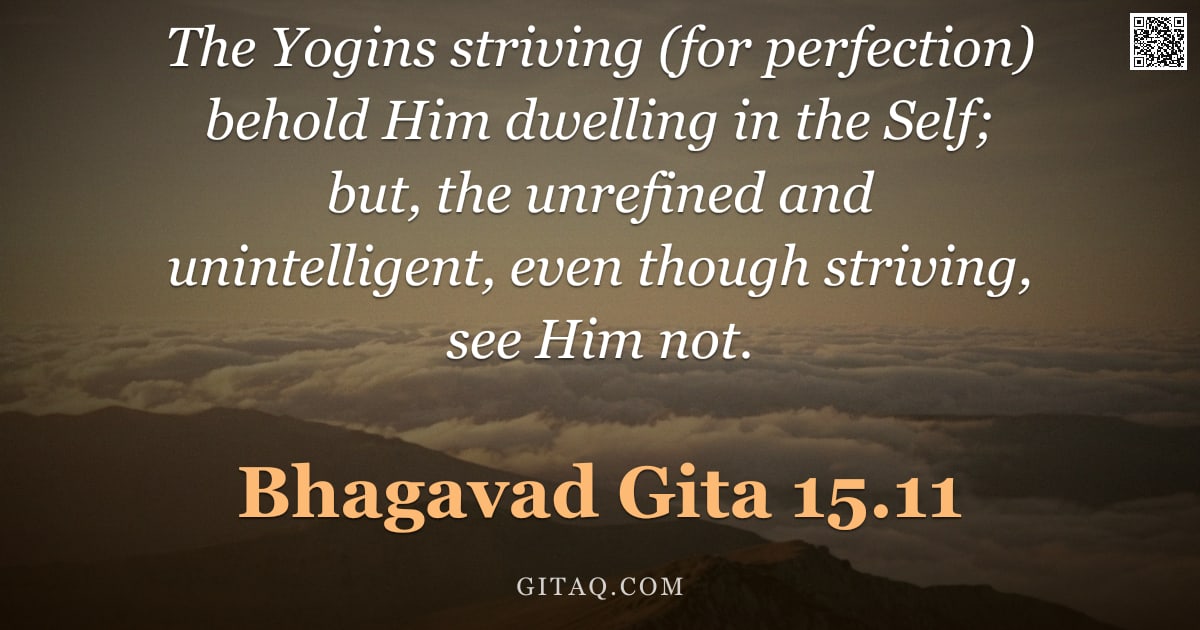
Bhagavad Gita 15.11
Purushottama Yoga · English Translation
यतन्तो योगिनश्चैनं पश्यन्त्यात्मन्यवस्थितम् | यतन्तोऽप्यकृतात्मानो नैनं पश्यन्त्यचेतसः ||१५-११||
yatanto yoginaścainaṃ paśyantyātmanyavasthitam . yatanto.apyakṛtātmāno nainaṃ paśyantyacetasaḥ ||15-11||
What Does This Verse Mean?
In this verse, Lord Krishna explains to Arjuna that the Divine presence within everyone is visible only through deep spiritual practice and inner purification. Those who strive with genuine discipline and a refined heart can perceive God dwelling in their own soul. However, even if people try hard without true focus or moral clarity, they remain blind to this divine reality because their minds are clouded by impurities.
The Teaching Behind It
This verse bridges Jnana Yoga (the yoga of knowledge) and Dhyana Yoga (the yoga of meditation), emphasizing that intellectual understanding alone is insufficient without the purification of consciousness. It develops the concept that 'seeing' God in the Self is a direct experiential realization dependent on the clarity of the practitioner's mind, not just their physical effort.
Word by Word
Classical Commentary
Where This Happens
This verse appears in Chapter 15 during Krishna's discourse on the 'Purushottama Yoga' (The Supreme Person) to Arjuna on the battlefield of Kurukshetra. It follows a metaphor where life is compared to an upside-down banyan tree, and just before this, Krishna described how one must cut down that attachment with the weapon of detachment. Arjuna has been struggling with confusion about his duty; he needs assurance that despite his current doubts, the path to realizing the Divine is accessible through sincere effort.
Living It Out Today
Consider a professional facing a high-stakes decision at work where they feel overwhelmed by conflicting emotions and distractions like social media or office gossip. If they rush into action without pausing for inner clarity (refining their 'mind'), they will likely make choices driven by fear rather than wisdom, failing to see the best path forward. However, if they dedicate time each morning to meditate and clear their mental clutter before starting work, they may suddenly perceive a solution or ethical direction that was invisible while they were distracted.
Explained for Children
Imagine your mind is like a mirror covered in thick dust; no matter how much you look at it, the reflection of God stays hidden. The Yogis who practice and clean that mirror with good thoughts can finally see the bright light inside them clearly. But if someone tries to look while their hands are dirty or they aren't paying attention, the mirror stays cloudy, and they cannot see what is right in front of them.
Daily Reflection
You may feel like you are striving hard yet still feeling distant from what matters most; this verse reminds us that effort alone is not enough without purity of heart. The 'unrefined' mind acts as a veil, scattering our attention so we cannot see the Truth standing right before us in silence. Today, let your practice be about refining your focus rather than just adding more activity to your day.
A Practice for Today
Close your eyes and quiet the restless mind to turn inward, seeking not an external vision but a subtle awareness of the Divine presence within. As you breathe deeply, visualize the light that dwells in the Self, waiting for your inner focus to sharpen enough to perceive it.
Key Teachings
- The Necessity of Sattvic Striving
True spiritual vision requires effort (yatanta), but this effort must be coupled with the refinement of one's character and intellect. Without cleansing the heart, even vigorous practice yields no result. - The Internal Dwelling of the Divine
God is not a distant figure to be found only in temples or forests; He resides eternally within every living being as the Self. The seeker must turn their gaze inward (ātmanyavasthitam) rather than searching outward. - The Limitation of an Unrefined Intellect
Those who lack inner discipline and clarity (akṛtātmānaḥ) remain blind to the Divine despite their attempts. The intellect must be purified by yoga before it can function as a lens for spiritual sight.
Themes
Related Verses
Read This Next
- 2.47 — To understand how Krishna defines duty and detachment as the foundation for refining the mind before true perception.
- 3.30 — To explore the concept of surrendering actions to God, which is a key method for purifying one's inner nature (ātman).
- 12.15 — To see how Krishna describes His devotees who have purified themselves and thus become dear to Him.
Recommended Reading
GitaQ earns from qualifying purchases as an Amazon Associate.