Bhagavad Gita 13.22
Kshetra Kshetrajna Vibhaga Yoga · English Translation
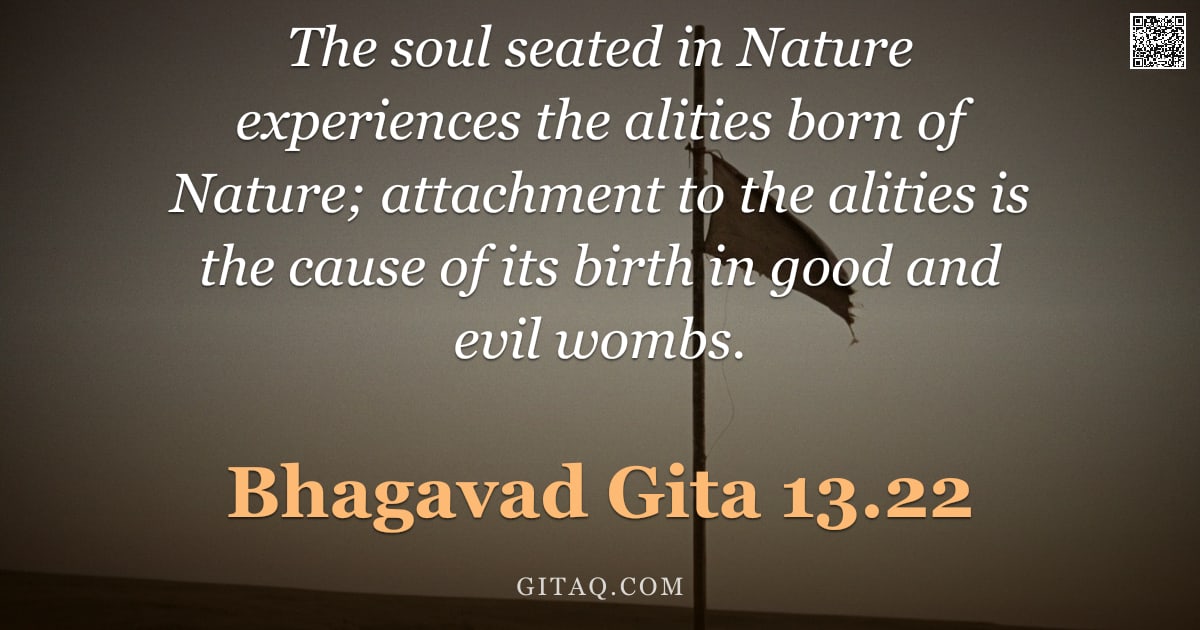
पुरुषः प्रकृतिस्थो हि भुङ्क्ते प्रकृतिजान्गुणान् | कारणं गुणसङ्गोऽस्य सदसद्योनिजन्मसु ||१३-२२||
puruṣaḥ prakṛtistho hi bhuṅkte prakṛtijānguṇān . kāraṇaṃ guṇasaṅgo.asya sadasadyonijanmasu ||13-22||
What Does This Verse Mean?
In this verse, Lord Krishna explains to Arjuna that the true Self (Purusha) is distinct from Nature but appears to experience pleasure and pain because it has identified with the three qualities of material nature (gunas). Just as a person sitting in a room feels the heat or cold without being the heat itself, the soul experiences life's ups and downs due to this association. Krishna teaches that our attachment to these changing conditions is what traps us in the cycle of birth and death, leading to various future existences based on past actions.
The Teaching Behind It
This teaching belongs to the Sankhya and Jnana Yoga strands, which focus on discriminative knowledge between the observer (Purusha) and the observed material nature (Prakriti). It develops the concept of 'Guna-sanga' (attachment to qualities), explaining that liberation comes from realizing one is not the experiencer but merely the witness who has temporarily associated with the changing modes of goodness, passion, and ignorance.
Word by Word
Classical Commentary
Where This Happens
This verse occurs during the Bhagavad Gita on the battlefield of Kurukshetra, where Krishna is guiding Arjuna through his deep crisis of confusion about duty versus compassion. After explaining that the body is merely a field (Kshetra) and the soul is its knower (Kshetrajna), Krishna now clarifies why the eternal soul seems to suffer or enjoy in this world. At this moment, Arjuda is still struggling with grief for his kin; he needs to understand that suffering arises not from the events themselves, but from his identification with them.
Living It Out Today
Consider a professional who receives harsh criticism at work and immediately feels their self-worth crumble into shame. Instead of viewing this feedback as an external event happening in the 'field' of their career, they identify entirely with it ('I am bad'), causing severe anxiety that affects their family life later that day. By applying this verse's wisdom, one can observe the criticism without attachment, recognizing that while the work situation is a result of natural qualities (gunas), their core identity remains untouched by failure or success.
Explained for Children
Imagine you are wearing a blue raincoat while standing outside; if it rains heavily, your coat gets wet, but *you* (the person inside) don't become water. This verse says the soul is like that person: it wears the 'clothes' of nature to experience life, feeling happy or sad depending on what happens around us. However, just like you can take off a raincoat when the sun comes out, we must learn not to get too attached to these feelings so we don't keep getting stuck in difficult situations again and again.
Daily Reflection
You often feel overwhelmed by circumstances because you forget that you are the silent witness sitting within them, not the storm itself. This verse reminds us that every joy or sorrow we taste comes from the interplay of nature's qualities acting upon our awareness. When you realize it is just Nature playing with its own parts rather than a personal attack on your soul, the heavy weight of 'good and bad' begins to loosen.
A Practice for Today
Sit quietly and observe how your current thoughts, emotions, or physical sensations arise not from you as the observer, but like waves appearing on the ocean of nature. Gently notice where you are clinging to these experiences as 'mine,' recognizing that this attachment is what binds consciousness to a specific type of existence.
Key Teachings
- The Witnessing Self
The true essence of you (Purusha) is distinct from the body-mind complex; it merely sits within Nature as a passive observer. Just as a mirror reflects images without being stained by them, your consciousness experiences life's events without truly becoming them. - The Illusion of Agency
While we feel like the doer and experiencer of happiness or pain, it is actually the Gunas (qualities) of Nature acting upon one another. We mistake this mechanical process for our personal identity, leading to a false sense of ownership over life's outcomes. - The Root of Samsara
Suffering and rebirth are not punishments from an external deity but the natural result of attachment (sanga) to these fleeting mental states. This identification with the changing qualities creates a cycle that pulls consciousness into various births based on past conditioning.
Themes
Related Verses
Read This Next
- 2.47 — Read this next for Krishna's instruction on performing duty without attachment to results, which directly addresses how to break the cycle of binding actions.
- 3.30 — This verse offers a practical method of surrendering all works to the Divine, helping the practitioner shift from ego-driven action to selfless service.
- 12.15 — After understanding the mechanics of bondage here, this chapter on Bhakti Yoga shows how loving devotion acts as a powerful force for liberation and peace.
Recommended Reading
GitaQ earns from qualifying purchases as an Amazon Associate.