Bhagavad Gita 11.3
Vishvarupa Darshana Yoga · English Translation
एवमेतद्यथात्थ त्वमात्मानं परमेश्वर | द्रष्टुमिच्छामि ते रूपमैश्वरं पुरुषोत्तम ||११-३||
evametadyathāttha tvamātmānaṃ parameśvara . draṣṭumicchāmi te rūpamaiśvaraṃ puruṣottama ||11-3||
What Does This Verse Mean?
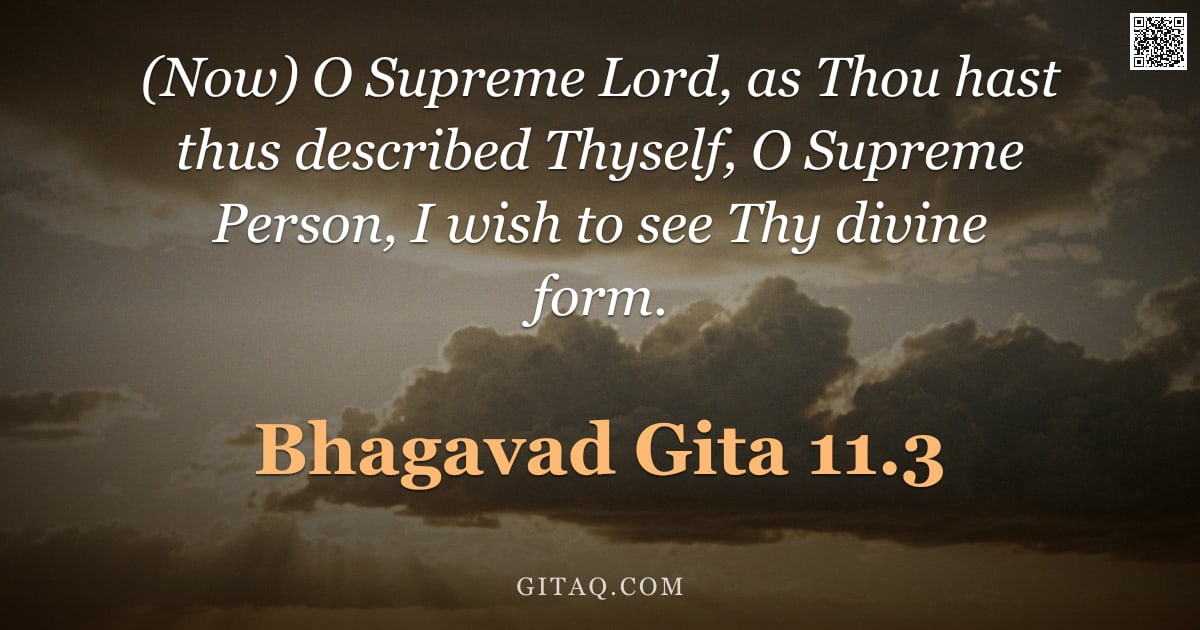
In this verse, Arjuna responds to Krishna's initial description of his divine nature by expressing a deep desire to see the Lord's cosmic form directly. Speaking from humility and awe, he addresses Krishna as the Supreme Lord and asks for permission to witness His universal body. The key teaching is that while intellectual understanding is valuable, true devotion often seeks a direct, visionary experience of the Divine presence.
The Teaching Behind It
This verse is a cornerstone of Bhakti Yoga (the yoga of devotion), specifically illustrating the concept of Darshana, or seeking vision of the Divine as an act of love and surrender. While rooted in Jnana Yoga's pursuit of truth about the Self, it prioritizes the devotee's emotional readiness to receive grace through direct revelation rather than mere intellectual argument.
Word by Word
Classical Commentary
Where This Happens
This conversation takes place on the battlefield of Kurukshetra, just moments before Krishna begins his most spectacular display of power. Arjuna has just listened as Krishna described His infinite nature and universal form in abstract terms during Chapter 10. Overwhelmed by a mix of fear and reverence after hearing this description but not yet seeing it visually, Arjuna now requests to witness the actual vision he was promised.
Living It Out Today
Consider a professional facing an uncertain career pivot who has read all the advice books (intellectual knowledge) but still feels anxious about making the move. This verse mirrors that moment when they decide they need more than just theory; they seek mentorship, a pilot project, or a deep inner realization to truly 'see' their path before committing fully. It encourages moving from passive study of problems to active engagement with solutions through direct experience.
Explained for Children
Imagine you are reading a story about a superhero who says they can do amazing things, but you have never seen them in person yet! Arjuna feels like he has heard wonderful stories about Krishna's power and is now saying, 'Please show me that amazing form so I can really understand it.' It is just like wanting to see the view from the top of a big hill after someone tells you how beautiful it looks. This verse teaches us that sometimes we need to look closer or ask for help to truly appreciate something wonderful.
Daily Reflection
Today, I invite you to pause and consider how often we settle for small views when a grander reality is available just beyond our perception. Like Arjuna asking to see the Lord's true form, perhaps there are aspects of your own life or spirit that need this deeper revelation to be fully understood and loved. When you shift from seeing only the surface to seeking the divine essence within all things, fear gives way to a profound sense of wonder.
A Practice for Today
Close your eyes and silently acknowledge that just as Arjuna trusted the Lord's description, you too can trust the divine nature revealed to us through scripture. Visualize a light within you that holds all forms yet remains untouched by them, inviting this cosmic presence into your current moment of stillness.
Key Teachings
- The Power of Authentic Description
Arjuna's request follows directly after Krishna has described His nature through words; true knowledge often begins with the authority of divine instruction. We must first accept the description given by the Teacher before we can hope to realize that reality in our own vision. - The Divine as Supreme Person
Even within the vast, terrifying cosmic form, Krishna is addressed as 'Puruṣottama,' meaning the Supreme Person who transcends all matter. This reminds us that the infinite universe does not replace personal devotion but reveals it in its most majestic light. - The Yearning for Direct Experience
Knowledge alone is insufficient without the desire to witness; Arjuna moves from hearing about God to asking to see Him. This verse teaches that spiritual study must ignite a deep, personal longing for direct communion with the Divine.
Themes
Related Verses
Read This Next
- 2.47 — Read this next for Krishna's foundational instruction on performing duty without attachment before witnessing such a form.
- 3.30 — This verse offers the practical method of dedicating all actions to God, preparing the heart to receive divine vision.
- 12.15 — After seeing the cosmic form in Chapter 11, this verse from the Bhakti Yoga chapter describes the qualities that make one dear to Krishna.
Recommended Reading
GitaQ earns from qualifying purchases as an Amazon Associate.