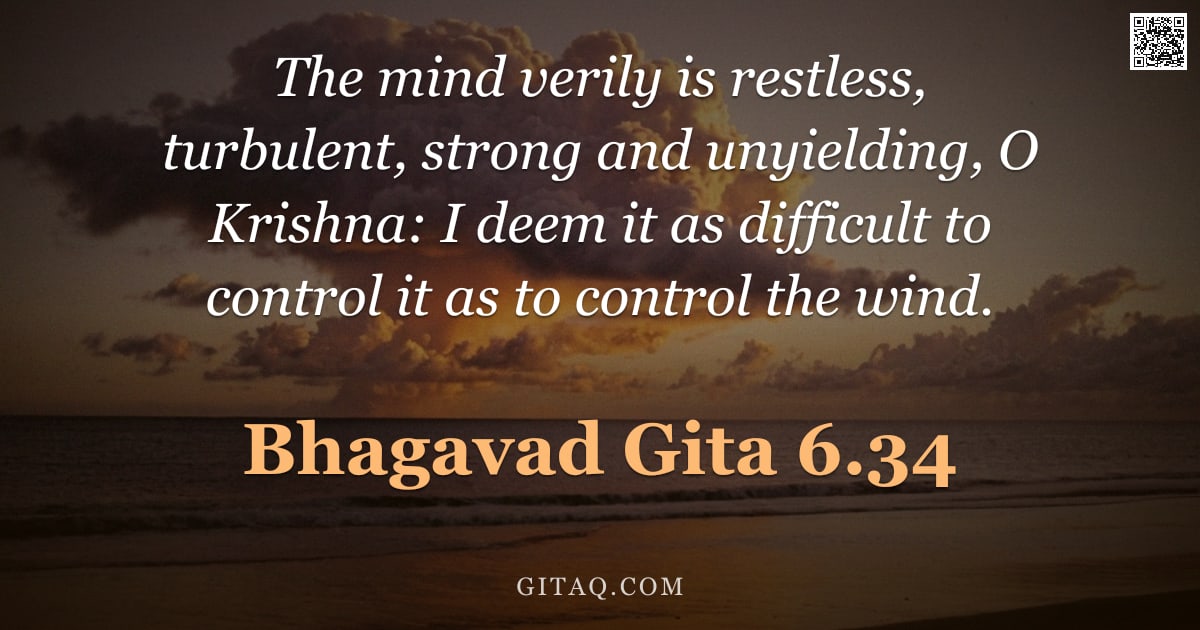
Bhagavad Gita 6.34
Dhyana Yoga · English Translation
चञ्चलं हि मनः कृष्ण प्रमाथि बलवद् दृढम् | तस्याहं निग्रहं मन्ये वायोरिव सुदुष्करम् ||६-३४||
cañcalaṃ hi manaḥ kṛṣṇa pramāthi balavad dṛḍham . tasyāhaṃ nigrahaṃ manye vāyoriva suduṣkaram ||6-34||
What Does This Verse Mean?
In this verse, Arjuna speaks to Krishna and admits that the human mind is incredibly difficult to master because it is restless, turbulent, strong, and stubborn. He compares trying to control the mind to attempting to stop the wind with one's hands, emphasizing how elusive and powerful mental distractions are. The key teaching here is an honest acknowledgment of the immense challenge in meditation and self-control, setting the stage for Krishna to offer practical solutions rather than just ideals.
The Teaching Behind It
This verse belongs specifically to Dhyana Yoga (the path of meditation) and addresses the practical obstacles within Sankhya philosophy regarding the nature of the mind. It highlights that while the Self is pure consciousness, the instrument used for realization—the mind—is naturally volatile due to its inherent qualities (Gunas). This acknowledgment establishes the necessity of persistent practice (abhyasa) and dispassion (vairagya) as essential methods before one can attain true mental stillness.
Word by Word
Classical Commentary
Where This Happens
This verse occurs during the conversation on the battlefield of Kurukshetra, where Prince Arjuna has just refused to fight his own relatives and teachers. After Krishna outlined various paths like duty (karma yoga) and knowledge (jnana yoga), Arjuna attempts to follow the path of meditation but hits a wall with his own mind. Feeling defeated by his inability to still his thoughts despite wanting to do so, he confesses this difficulty to Krishna as part of their ongoing dialogue on spiritual discipline.
Living It Out Today
Consider a professional trying to work from home during a crisis while receiving constant notifications and feeling overwhelmed by anxiety about the future; they cannot focus because their mind keeps jumping between tasks. Like Arjuna's realization, pushing harder against these distractions often makes them worse, leading to frustration and burnout. The solution is not just 'trying harder' but recognizing this natural restlessness as a challenge that requires specific tools—like mindfulness breaks or structured routines—to manage the wind of thoughts rather than fighting it blindly.
Explained for Children
Imagine your thoughts are like a kite flying high on a windy day; they jump around, fly fast, and refuse to stay still. Even if you try hard to grab that kite or hold it down, the wind keeps blowing it away in different directions. Arjuna tells Krishna that our minds work just like this restless wind—they want to go everywhere at once! That's why learning to focus is very hard for everyone.
Daily Reflection
You are not failing because your thoughts race; you have only just begun to notice their true nature as turbulent and strong forces. It can feel disheartening when discipline seems impossible against such power, but remember that even controlling the invisible wind is deemed difficult by the divine itself. Your journey begins with this honest recognition of the struggle, which is the very first step toward genuine mastery over your inner landscape.
A Practice for Today
Sit quietly and simply observe your mind as it flits from thought to thought, without trying to stop the movement or judge its turbulence. Acknowledge that this restlessness is natural for the untrained mind, much like wind blowing across a field.
Key Teachings
- The Nature of Restlessness
Krishna identifies five specific characteristics of the uncontrolled mind: it moves quickly (cañcala), causes agitation, possesses immense energy, and resists change. Recognizing these traits is essential because fighting a concept you do not understand leads to frustration rather than progress. - The Analogy of the Wind
Just as one cannot physically grasp or bind the wind with hands, the mind's subtle and pervasive energy makes it incredibly hard to constrain by force. This analogy teaches that willpower alone is often insufficient; one needs a methodical approach rather than brute strength. - The Path of Acknowledgment
By admitting the difficulty, Arjuna opens the door for divine guidance and practical techniques to follow. The verse establishes that control is not an instant event but a disciplined practice (nigraha) requiring patience and steady effort.
Themes
Related Verses
Read This Next
- 2.47 — Read this next to understand that while action is required, you must not be attached to the fruits of your efforts in taming the mind.
- 3.30 — This verse offers a method for surrendering actions and their results to the Divine, which helps calm the turbulent ego-driven desires.
- 12.15 — Read this to discover how Krishna describes the qualities of his devotees who have successfully steadied their minds through compassion and equanimity.
Recommended Reading
GitaQ earns from qualifying purchases as an Amazon Associate.